Your invitations are the first thing guests hold in their hands, so they’re worth getting right. Here’s where to order them, what each site does well, and what to watch out for.
Picking a wedding invitation website is harder than it should be. Every site promises gorgeous designs and easy customizing, and then you’re three hours deep in a design tool at 11 pm wondering why the font won’t cooperate. We checked eight of the biggest names, their actual prices, how the paper feels, and how much freedom you have to make the design your own. Here’s the short version.
1. Mixbook
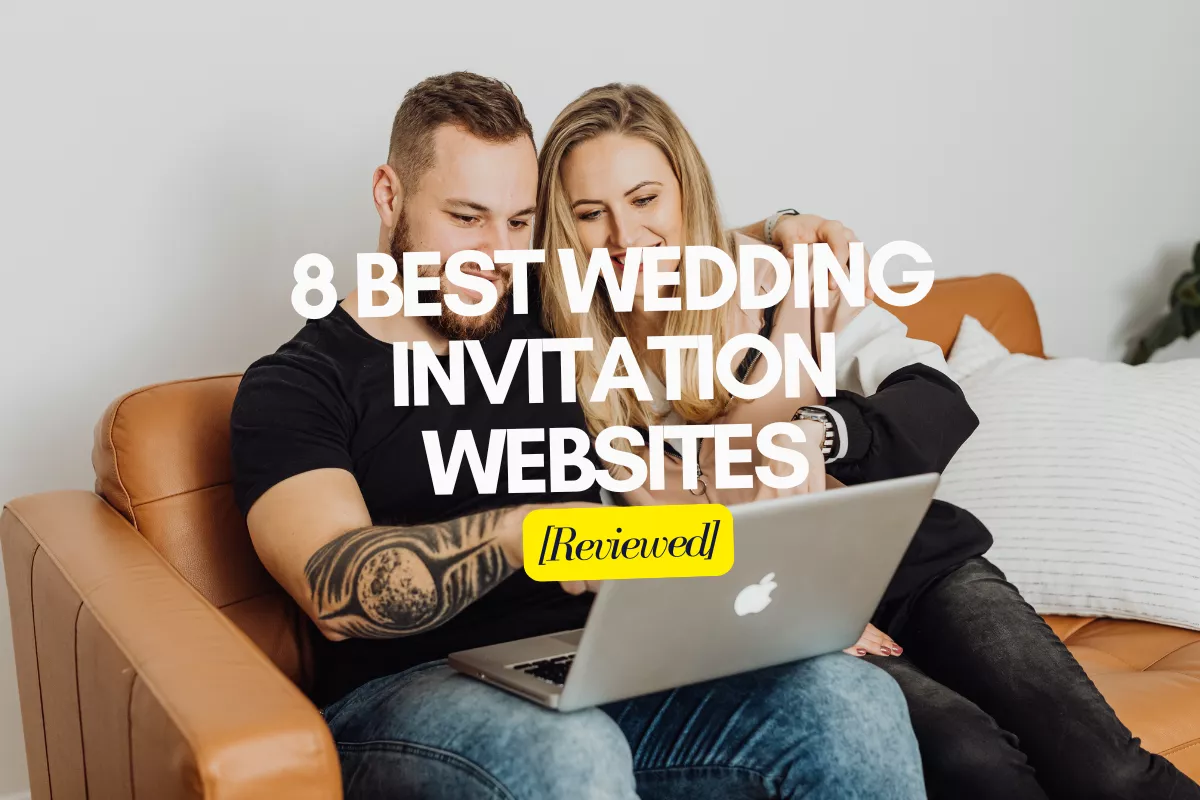
Mixbook is the pick if you want your own photos on the invitation or if you want to change a template rather than just fill it in. Their editor lets you move, resize and swap almost every element, which is unusual at this price point. Most sites lock the layout and only let you edit the text.
The design range covers the usual floral and minimalist directions, plus a Martha Stewart collection, and there are real foil options if you want a little shine without jumping to letterpress money. Formats include flat, folded and magnet.
What makes it genuinely useful for weddings is that everything matches. If you like the idea of personalized wedding invitations built around your engagement photos rather than a stock illustration, you can carry that same design through save the dates, RSVP cards, detail cards and thank you notes, so the whole suite looks like it belongs together.
Best for: photo invitations, heavy customizing, matching suites
2. Zola
Zola’s advantage isn’t the designs, it’s the plumbing behind them. Your invitations connect to the same guest list you’re already keeping, so addresses flow straight into envelope printing and RSVPs land back in the same place instead of a shoebox on your counter.
For couples already using their free wedding website, ordering invitations through Zola removes a whole layer of copying names between spreadsheets. Free envelope printing on most orders helps too.
Best for: couples who want guest lists, RSVPs and paper in one system
3. Greenvelope
If you’ve decided against paper altogether, Greenvelope’s digital wedding invitations are the most wedding-appropriate version of that idea. The designs are restrained rather than cute, and the RSVP tracking, guest messaging and reminder tools are the real product.
You’ll spend a fraction of what printing costs and you’ll know exactly who has opened it. For destination weddings where half your list is scattered across time zones, that visibility is worth a lot.
Best for: digital-only couples, destination weddings, tight timelines
4. Minted
Minted runs on submitted designs from independent artists, which is why their catalog looks different from everyone else’s. If you’re tired of seeing the same eucalyptus wreath on every site, this option is the fix.
The paper is genuinely good, the foil work is clean, and their free sample kit lets you feel the stock before committing. Prices sit at the higher end, though sales run often enough that it’s worth waiting for one.
Best for: designer-led looks, quality paper
5. Basic Invite
Basic Invite exists for the person who wants the blush a little dustier. You can recolor individual elements on the card from more than 180 color options and preview the change instantly, which almost nobody else offers at this level.
Envelopes come in over 40 colors and they’re all peel and seal, which sounds minor until you’re facing 120 of them at your kitchen table. They’ll also print a custom sample of your actual finished design before you commit to the full run.
Best for: exact color matching, ordering a real sample first
6. Paperless Post
Paperless Post started digital and still does that better than anyone. Their online invitations look like paper rather than a form, with envelope animations, liners and real designer collaborations behind them.
They print now too, but the digital side is the reason to go here. It works especially well for the events around the wedding: engagement party, rehearsal dinner, and day-after brunch. Sending those digitally saves real money without anyone feeling shortchanged.
Best for: digital invitations, secondary events
7. Shutterfly
Shutterfly is the volume option. The designs are safe rather than exciting, but the sales are aggressive and the turnaround is quick, which matters if your timeline slipped.
If you’re inviting 200 people and the invitation budget is a couple hundred dollars, this is a sensible answer. Photo cards are their strong suit, and the pricing on large runs is hard to beat.
Best for: large guest lists on a tight budget, fast turnaround
8. Etsy
Etsy isn’t one shop, it’s thousands, and that’s both the appeal and the catch. You’ll find work here that doesn’t exist anywhere else, plus printable templates you can edit yourself and send to a local printer for a fraction of the cost.
Read the reviews and check the shop’s turnaround time before ordering. Ask for a proof. Sellers vary enormously, and there’s no central quality control catching mistakes for you.
Best for: unique designs, printable templates, working directly with a designer
Which One Is Right for You?
| Your own photos on the invitation | Mixbook |
| Designs nobody else will have | Minted or Etsy |
| Guest list and RSVPs handled in one place | Zola |
| An exact color match | Basic Invite |
| Beautiful digital invitations | Paperless Post or Greenvelope |
| The lowest price on a big order | Shutterfly |
Price is usually the tiebreaker, and it shouldn’t be a painful one. There’s a whole guide to affordable invitations that don’t look cheap if you’re working with a tight number and the short version is that print method matters far more than which site you pick.
One rule holds no matter which you choose: order a printed sample before the full run. Screens lie about color, and paper weight is impossible to judge from a product photo. Most of these sites will send you one for a few dollars, and it’s the cheapest insurance in wedding planning.
What Wedding Invitations Cost in 2026
It helps to know the number you’re working against before you fall in love with a design. According to The Knot Worldwide’s 2026 Real Weddings Study, which drew on more than 10,000 US couples married in 2025, the average wedding cost about $34,000, with roughly 117 guests on the list. Stationery is a small slice of that, but it’s a slice with a wide range: most couples land somewhere between $200 and $500 on the paper.
Here’s what actually moves the price:
- Print method, which is the biggest lever by far (digital printing runs roughly $1 to $3 a card, while letterpress and foil can hit $6 to $15)
- Paper weight and finish, since double-thick cotton stock adds up fast
- Quantity, because most sites drop the per-card price sharply above 100
- Extras like envelope liners, vellum wraps, wax seals and calligraphy addressing
- Postage, which almost everyone forgets until the very end
That last one deserves its own section, because it catches more couples than anything else on the list.
The Postage Trap Nobody Warns You About
Square invitations are everywhere right now, and they cost more to mail. The Postal Service classifies mail by shape, and under the USPS physical standards for letters, anything with a length-to-height ratio below 1.3 counts as non-machinable. A square envelope has a ratio of 1.0, so it fails automatically, no matter how light it is.
The same rule catches wax seals, ribbon, and anything rigid enough that it won’t bend through a sorting machine. Each of those triggers a per-piece surcharge, currently 49 cents, stacked on top of your regular postage.
Assemble one complete invitation, then run its weight and dimensions through the USPS postage price calculator before you buy a single stamp. A few things that help once you know the number:
- Weigh a fully assembled invitation at the post office before buying any stamps
- Put a square invitation inside a rectangular outer envelope to sidestep the surcharge
- Use postcard-style RSVP cards instead of reply envelopes and save on every single one
- Ask for hand-canceling if your envelopes are delicate, which is free
Getting the Wording Right Before You Print
Nothing stings like spotting a mistake on 150 printed cards. Wording is where most of them happen, usually around who’s hosting.
The traditional structure puts the host names first, then the request line, then the couple, and finally the date, time, and place. The Emily Post guidelines for formal invitations are worth reading if your families are traditional or if the hosting situation is complicated by divorce, remarriage or both sets of parents contributing. Confused? See this guide on wedding invitation wording.
If you’re hosting yourselves, or you’d rather sound like people than a legal document, casual wording is completely fine now. “Together with their families” solves most awkward host questions in four words.
Before you approve the proof, check these:
- Every name spelt correctly, including middle names and titles
- The date and the day of the week actually match on a calendar
- Venue name and city, plus the full address only if the place is hard to find
- The RSVP deadline, set three to four weeks before your caterer’s final headcount
- Dress code, if you have one, so nobody has to guess
Then ask someone who wasn’t involved to read it. You’ve looked at it too many times to see the mistake.
When to Order and When to Mail
Working backwards from the wedding date keeps this simple.
Save the dates six to eight months ahead, or nine to twelve months for a destination wedding. Invitations go out six to eight weeks before, with the RSVP deadline three to four weeks after that.
Order the invitations about three months before the wedding. That leaves room for a sample, a round of proof corrections, printing and shipping, plus a week or two for addressing, which always takes longer than anyone expects. Foil and letterpress need longer, so add two extra weeks if you’re going that route.
Frequently Asked Questions
How much do wedding invitations cost on average?
The Knot’s 2026 study puts the average at about $220 for invitations alone and around $510 for a full stationery suite. Digital printing runs roughly $1 to $3 per card, while letterpress and foil can reach $6 to $15 each. Ordering 100 or more usually drops the per-card price significantly.
How many wedding invitations should I order?
Order one per household, not per guest, then add 15 to 20 extras. Those extras cover addressing mistakes, last-minute additions and the one you’ll want to keep. Reordering a small batch later costs far more per card than including them up front.
When should I send wedding invitations?
Six to eight weeks before the wedding for a local celebration, and three months ahead for a destination wedding. Set your RSVP deadline three to four weeks before your caterer needs the final count, which gives you time to chase the guests who don’t reply.
Are digital wedding invitations acceptable?
Yes, and they’re increasingly common, especially for destination weddings and shorter engagements. Digital costs a fraction of print and gives you real-time RSVP tracking. The main drawback is that some older guests miss emails entirely, so a small print run for those households is a reasonable compromise.
Do I need to order a printed sample?
It’s the best few dollars you’ll ever spend. Colors shift between screen and paper, and card stock weight is impossible to judge from a photo. Most sites offer samples, and Basic Invite will print a sample of your actual finished design rather than a generic card.
What’s the difference between a save-the-date and an invitation?
A save the date is an early heads-up with just your names, the date and the city, sent months in advance. The invitation carries the full details and comes much later. Anyone who receives a save-the-date must receive an invitation, so only send them to guests you’re certain about. If you’re weighing whether you need both, the save-the-date is the one you can skip on a tight budget.
Why do square wedding invitations cost more to mail?
USPS sorting machines can’t process square envelopes, so they carry a non-machinable surcharge on every piece regardless of weight. Wax seals, ribbon and rigid embellishments trigger the same fee. Placing a square card inside a rectangular outer envelope avoids it.
Should I print guest addresses or handwrite them?
Printed addressing is faster, cheaper and perfectly acceptable. Several sites, including Zola and Basic Invite, print recipient addresses free on most orders. Hand calligraphy looks beautiful but typically costs $2 to $5 per envelope and needs to be booked well in advance.
Can I include registry information on the invitation?
Traditional etiquette says no, and most stationers still advise against it. Put registry details on your wedding website instead and let the invitation or an insert card carry the website address. Word of mouth through your families handles the rest.
What paper weight should I choose?
Anything in the 110 lb to 130 lb range feels substantial without becoming difficult to mail. Lighter stock feels flimsy in hand, and double-thick cotton stock above 130 lb looks gorgeous but adds weight and can push you into the next postage tier. If you’re unsure, order samples in two weights and compare.
Do I need to buy stamps before assembling the invitations?
No, and you shouldn’t. Assemble one complete invitation first, take it to the post office, and have them weigh and measure it. Buy stamps only after you know the exact postage. Guessing is how people end up with 100 returned invitations three weeks before the wedding.
Wedding invitations are one of the few parts of the day that guests keep. Most couples land on the right site once they know which of these matters most to them: the design, the customizing, the price, or the logistics. Order a sample, check the wording twice, weigh one at the post office, and the rest is just picking a font you like.