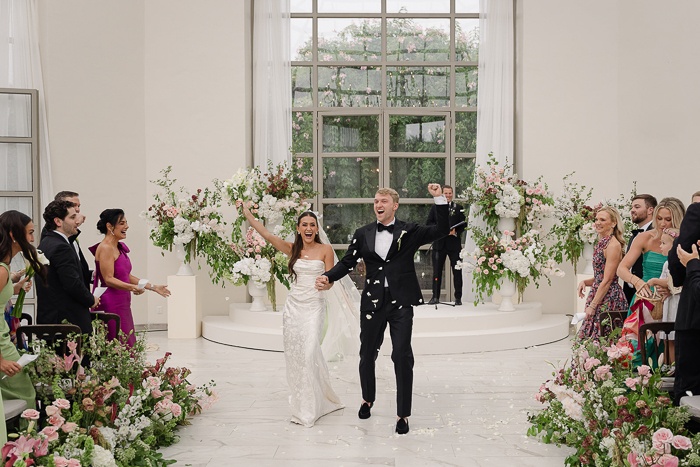
Bright and celebratory, fresh and festive, unexpected and unforgettable: Our Color of the Year, Island Citrus, is a showstopping way to anchor—or accent—any wedding palette. But if you think it feels too modern for your vintage aesthetic, too neon for a minimalist floral design, or too bright against the tropical pinks you envisioned, think again: This yellow-green is surprisingly versatile, pairing perfectly with blooms in hues of blue, coral, pink, peach, purple, white, and brown.
“Muted yellow and green are part of the beauty of every flower: Every bloom has a stem, and within that green there’s always a touch of yellow,” says Jung Lee, founder of FETE and creative director. “The magic is that almost any flower can complement those tones, depending on the season. Pinks, blues, whites—all bring something unique.”
The shapes and textures of the flowers you choose can change the look of a muted chartreuse, too: Delicate ranunculus and roses are romantic and feminine; graphic anemones and sculptural orchids are contemporary and sleek; fluffy Queen Anne’s Lace and soaring delphinium add visual interest even in paler hues. “With shades of pinks, chartreuse can be quite romantic; with whites, it feels crisp, modern, and architectural,” says Lee. “With blues and purples, it becomes painterly and impressionistic. By layering shapes—from branchy to structured to cloud-like—you give dimension, allowing it to be woven through organically.”
Amanda Luu, owner of Studio Mondine, also looks to the muted yellow-greens that appear naturally on floral stems as inspiration to use the hue as a neutral, pairing it with nearly any other shade. “Chartreuse is one of those daring shades that can feel intimidating at first, but with the right floral companions, it becomes surprisingly versatile,” she says. “It can skew romantic with soft peaches, modern with black and white, or playful with corals and pinks. It’s all about letting the season, and your own story, guide the pairings.”
01 of 10
Sweet Peas
Photo by Jose Villa
Delicate, dainty sweet peas in a subtle lavender are a soft accompaniment to vivid citrus hues. “Ethereal, modern, and romantic—they are perfect for intimate spring weddings where delicacy is part of the story,” says Luu. “Sweet peas are deeply fragrant and instantly elevate a bouquet with their wild, whimsical nature. They’re fragile and need careful handling but are worth it for their texture and scent.”
02 of 10
Delphinium
Photo by Shannen Natasha for The Wedding Artists Co.; Floral Design by Dana Markos Events
A soft blue or periwinkle bloom—like delphinium—allows a muted chartreuse to shine at garden weddings, beachside nuptials, and country club receptions, “where a hint of blue connects to the landscape,” says Luu. “Their tall, spired form adds verticality and drama. They bring both structure and softness, depending on how they’re styled,” she says. “[Delphiniums are] stunning in ceremony arches, large-scale installations, or as a surprise pop in centerpieces; their height makes them especially effective for framing moments of scale.”
03 of 10
Quicksand Rose
Photo by Nora Photography
The muted, pinkish tan of a Quicksand rose lends a vintage vibe to a high-energy chartreuse palette. “One hums with energy, the other listens: Together they create stillness with a pulse beneath it, alive, restrained, and strangely intimate,” says Strong. “It’s less about contrast and more about conversation, a quiet exchange between daring and softness. The feeling of neon and nude has unique modernity that creates a very clean and confident look.”
04 of 10
Butterfly Ranunculus
Photo by Jose Villa
Place citrus blooms against the pale, rosy hue of delicate Butterfly ranunculus for an aesthetic that’s both modern and timeless. “There’s something about pairing rose pink with chartreuse that feels very alive,” says floral designer Shean Strong. “The warmth of rose pink softens chartreuse’s sharp vibrancy, creating a dialogue between tenderness and energy. It’s a pairing that feels fresh from the garden: romantic, unexpected, and full of movement. Together they bring a sense of joy and vitality that commands attention without ever feeling forced.”
05 of 10
Anemones
Photo by Trent Bailey Photography
Anemones, famous for their crisp, black centers set against flawless white petals, are a high-contrast visual element against lemon-lime shades at modern, minimalist affairs. “Sleek, modern, and a little edgy—they keep the palette graphic and bold without competing for attention,” says Luu. “Their stark simplicity makes them endlessly versatile. They’re both approachable and statement-making.” Typically easy to source, even in the cooler months of winter and spring—”and fairly cost-effective compared to other delicate blooms,” says Luu—anemones can accent wedding party bouquets, streamlined centerpieces, and aisle arrangements.
06 of 10
Peach or Blush Garden Roses
Photo by Amber Gress Photography
Roses in blush or pale peach add a timeless touch to a fresh citrus palette. “The soft, romantic petals of garden roses bring balance to chartreuse’s sharp energy. The warmth of peach or blush tones beautifully bridges with the freshness of green, creating harmony without looking too sweet,” says Luu. “They’re particularly lovely for spring weddings, when a couple wants a timeless palette that still feels fresh, with a bit of edge.”
This versatile bloom works throughout your day’s floral design in bouquets, centerpieces, and ceremony arrangements; Luu suggests leaving “artful, elegant thorns” for a modern, less-expected look. “Each garden rose has its own personality: ruffled petals, fragrance, and subtle shifts in hue,” she says. “Open air-grown heirloom varieties can be more costly, but they’re worth it for the depth of color.”
07 of 10
Coral Ranunculus
Photo by Carmen Santorelli
Delicate, textured ranunculus add layers of depth to a floral design, says Lee, while Luu likes them for adding “movement and playfulness”—a natural pairing alongside equally whimsical citrus. “When using bright coral, ranunculus can be electric next to chartreuse, keeping the palette lively and full of energy—perfect for maximalist or organic-leaning weddings in spring,” says Luu. “Few flowers have the same textural depth as ranunculus. They unfurl over time in arrangements, revealing more painterly petals each day—ideal for bridal bouquets, boutonnieres, and any design where scale and whimsy are welcome.”
08 of 10
Apricot or Dusty Rose-Colored Dahlias
Photo by James X Schulze; Floral Design by Bare Root Flora
The lush, muted tones of dahlias are a natural complement against the green-gold undertones of a muted chartreuse. “Dahlias bring saturation and a velvety texture that enhance chartreuse without overpowering it,” says Luu. “They’re quintessential for late summer and fall weddings, and they feel especially dramatic in vineyard or estate settings.”
Choose oversized, “dinner-plate blooms” for centerpieces, arches, and ceiling installations, or add “petite, pom-pom” versions as a supporting player in bouquets and arrangements. “Dahlias bring a strong geometry, so I tend to cluster and layer them for a more naturalistic look,” says Luu.
09 of 10
Blue Muscari
Photo by Adriana Rivera; Floral Design by Tatiana Angel of CCC Event Planning
The deep, blue-purple globes of blue muscari offer an elegant backdrop for splashy, citrus-hued flowers. “I love pairing blue with chartreuse because, on the color wheel, they sit opposite each other, creating a balance that feels both grounded and electric,” says Strong. “Blue brings depth and composure, while chartreuse introduces energy and freshness. Together, they strike that rare harmony; elegant and bold, yet entirely unexpected.”
10 of 10
Chocolate Queen Anne’s Lace or Chocolate Lisianthus
Photo by Kate Headley
For an aesthetic that’s unexpectedly elegant—and a little bit earthy—add rich browns to your chartreuse-based palette. “Chartreuse and chocolate have an ease together that feels quietly confident,” says Strong. “The brightness of chartreuse cuts through the weight of brown, bringing light to what might otherwise feel too grounded. There’s something effortless about the combination: It feels warm and modern, but familiar. It feels like moss under sunlight, a balance of earth and energy.”