By the Modern Weddings editors
Updated October 26, 2026: every rule below checked against the Emily Post Institute’s invitation guides.
Wedding invitation wording follows one order: who’s hosting, the request line, your names, the date, the time, the venue and city, then the reception line and how to reply. Formal wording spells everything out and says “the honour of your presence” for a ceremony in a house of worship and “the pleasure of your company” anywhere else. Casual wording keeps the same order and loosens the language.
Below are copy-ready examples for every hosting situation, from your parents paying to the two of you hosting, plus how to write the date, what goes on the RSVP card and what belongs on the details card instead. The example wordings are ours. The rules come from the Emily Post Institute, which our editors read line by line on October 26, 2026. If you’re still choosing paper, start with where to order wedding invitations, then come back with your font picked out.
Jump to: The order | Couple hosting | Parents hosting | Divorced parents | Formal | Casual | Date and time | Reception lines | RSVP cards | Details cards | Mistakes | FAQ
What goes on a wedding invitation, in order?
- The host line. Whoever is hosting: your parents, both families, or the two of you.
- The request line. “Request the honour of your presence,” “request the pleasure of your company” or a casual “invite you to celebrate.”
- Your names. Joined by “to” or “and.”
- The date. Day of the week, then the date, then the year.
- The time.
- The venue, then the city and state.
- The reception line. “Reception to follow” or the reception venue, if it’s somewhere else.
- The reply line. Usually handled by a separate RSVP card.
Everything else (dress code, hotel block, shuttle times, your wedding website) goes on a details card. Gift and registry information doesn’t go in the envelope at all: Emily Post’s invitation dos and don’ts call it “in poor taste” to include it.
How do you word an invitation when the couple is hosting?
When you and your partner are paying, or simply want to be the ones doing the inviting, you become the host line, and the invitation is to “their marriage.”
Formal, ceremony in a house of worship (our example):
Ms. Maya Elise Carter
and
Mr. Jordan Lee Patel
request the honour of your presence
at their marriage
Saturday, the twelfth of June
two thousand twenty-seven
at half after four o’clock
Saint Mark’s Church
Charleston, South Carolina
Reception to follow
Relaxed, anywhere else (our example):
Maya Carter and Jordan Patel
invite you to celebrate their marriage
Saturday, June 12, 2027
at four-thirty in the afternoon
The Cedar Room
Charleston, South Carolina
Dinner and dancing to follow
Want your parents in there without making them hosts? “Together with their families” above your names does it, and it’s the line we’d pick for most couples splitting costs three or four ways.
How do you word a wedding invitation when parents are hosting?
Emily Post’s rule is that the hosts issue the invitation. When one set of parents hosts, their names lead, and the invitation is to “the marriage of their daughter” or “their son.” If your parents share your last name, Emily Post says to use only your first and middle names. The person marrying into the family gets their full name, with a title on a formal card.
Mr. and Mrs. David Alan Carter
request the pleasure of your company
at the marriage of their daughter
Maya Elise
to
Mr. Jordan Lee Patel
Saturday, the ninth of October
two thousand twenty-seven
at five o’clock
The Linden Inn
Woodstock, Vermont
To include the other parents without making them co-hosts, add a line under the second name: “son of Mr. and Mrs. Raj Patel.” That’s one of the hosting setups in Emily Post’s sample invitation wording, and it’s a kind move when one family is paying but both are thrilled.
What if both families are hosting?
List both sets of parents, then “the marriage of” and both of your names. Or skip the parents’ names entirely with “Together with their families,” which reads warmer and saves a long host block when stepparents are involved.
Together with their families
Maya Elise Carter
and
Jordan Lee Patel
request the pleasure of your company
at their marriage
Saturday, the eighteenth of September
two thousand twenty-seven
at six o’clock
Harbor Hall
Chicago, Illinois
How do you word invitations with divorced or remarried parents?
Give each household its own line. When divorced and remarried parents host together, Emily Post’s sample lists one couple, then “and” the other couple on the next line, followed by “request the honour of your presence at the marriage of their daughter.” When one parent and a stepparent host, it becomes “at the marriage of her daughter” (or his son), which makes it clear whose child is getting married without anyone doing math at the mailbox.
Mr. and Mrs. Thomas Reed
and Mr. and Mrs. Paul Bennett
request the pleasure of your company
at the marriage of their son
Samuel James Bennett
and
Mr. Elliot Kim
Saturday, the twenty-fourth of April
two thousand twenty-seven
at four o’clock
Willow Creek Farm
Hudson, New York
“Honour of your presence” or “pleasure of your company”?
Emily Post’s formal wording guide is specific: “the honour of your presence” is for a ceremony in a house of worship, spelled with the British “u.” For any other venue, “the pleasure of your company” is the traditional choice. A barn, a hotel ballroom, a backyard and a city hall all get “pleasure.”
A few more formal rules from the same guide:
- Hosts’ names are spelled out in full, middle names included.
- “Mr.” and “Mrs.” stay abbreviated. “Doctor” is spelled out unless it makes the line too long.
- The year has no “and”: two thousand twenty-seven.
- For a Jewish wedding, “and” goes between the two names instead of “to.”
- When a Roman Catholic Mass is part of the ceremony, you can add “and your participation in the offering of a Nuptial Mass” under the names.
- “Black tie” can go in the lower right corner of a reception invitation if you need it. Nothing else about attire, and nothing about gifts.
Casual wedding invitation wording examples
Casual doesn’t mean vague. Emily Post’s informal wording guide drops titles and loosens the dates, but every card still says who’s hosting, what’s happening, where, when and how to reply. Some lines we’d happily steal:
- “Maya and Jordan are getting married, and we want you there.”
- “Please join us as we tie the knot.”
- “We’re getting married! Come celebrate with us.”
- “Grab your dancing shoes: Maya and Jordan are getting married.”
We’re getting married!
Maya Carter and Jordan Patel
Saturday, July 17, 2027
at 5 p.m.
Bluebird Barn, Asheville, North Carolina
Tacos, a bluegrass band and a lot of dancing to follow
Match the card to the party. If the wording says tacos and the dress code says black tie, guests will text you, and they’ll be right to.
How do you write the date and time on a wedding invitation?
On a formal invitation, spell out everything. Emily Post’s rules: the date and year are written out, the day of the week and the month are capitalized, the year is lowercase, and times on the half hour use “half after,” not “half past” or “four-thirty.”
| Saturday, the twelfth of June | Saturday, June 12 |
| two thousand twenty-seven | 2027 |
| at half after four o’clock | at 4:30 p.m. |
| at noon | at noon |
Emily Post says “in the afternoon” and “in the evening” aren’t necessary. The Knot’s guide to writing the date and time adds them, and recommends “noon” instead of “12:00 p.m.” Our take: add “in the morning” for a morning ceremony, because “eleven o’clock” alone makes people wonder, and leave the rest off.
Put the real start time, not a fake early one. Lindsay Buwalda, founder of the California planning company Bliss Productions, told The Knot she steers couples toward the actual start time, with a line like “Ceremony begins promptly at half after five o’clock” if they’re worried about late arrivals.
How do you word “reception to follow”?
If the reception is in the same place right after the ceremony, one line at the bottom covers it.
- Reception to follow
- Dinner and dancing to follow
- Reception immediately following
If the reception is somewhere else, give it its own lines: “and afterward at the reception,” then the venue and its street address. That’s how Emily Post’s sample does it. If there’s a gap of a few hours, add the reception time too.
What if you’re only inviting guests to the reception?
When the ceremony is private (an elopement, a city hall morning, a ceremony abroad), invite people to the party and say so plainly. Our example:
Maya and Jordan
were married in a small ceremony this spring
Please join us for a celebration
Saturday, the thirteenth of November
two thousand twenty-seven
at seven o’clock
The Foundry
Seattle, Washington
How do you word an adults-only wedding invitation?
The envelope does the work. Whoever’s name is on it is invited, and anyone whose name isn’t, isn’t. Emily Post’s advice on RSVPs that add uninvited children is to call and “keep the focus on who is invited” (“the invitation was only for you and Henry”), and to “stay strong but kind” if they push.
Our advice: don’t print “adults only” or “no children” on the invitation itself. Put a line on the details card or your wedding website instead, such as our version: “We love your little ones, but our celebration is just for grown-ups.” On the RSVP card, “We’ve reserved two seats in your honor” closes the loop politely.
Destination wedding invitation wording
Same wording, two changes: spell out the full place, country included, and send everything earlier, starting with your save-the-dates. Our guide to when to send save the dates covers how far ahead destination guests need to know. Our example:
Together with their families
Maya Carter and Jordan Patel
invite you to celebrate their marriage
Saturday, the sixth of March
two thousand twenty-seven
at five o’clock
Hacienda Las Palmas
San Miguel de Allende, Guanajuato, Mexico
Welcome drinks, the beach day and the farewell brunch go on a details card or the website, not on the invitation.
Second wedding invitation wording
If you’re hosting your own second wedding, the couple-hosting wording above fits. If you have children, there’s a lovely option in Emily Post’s informal samples: the kids host. Their version reads “Elizabeth Masterson and Susan and Michael Stevens invite you to celebrate the marriage of their parents,” followed by both parents’ names. Emily Post’s basics for remarriage also say to tell your children first, before anyone else hears the news.
Same-sex wedding invitation wording
There’s no separate rulebook. Use any wording on this page, with “and” between your names. Which name goes first is your call: alphabetical, whoever’s family is hosting, or whichever sounds better out loud (say it ten times and you’ll know). Titles are optional on a formal card, and if you use them, use the ones each of you goes by. The parents-hosting versions work the same way, with “and” between the names, as in the divorced-parents example above.
What should the RSVP card say?
Emily Post’s response card guide uses this layout, and it still works:
M______________________
____ accepts
____ regrets
The favour of your reply is requested by May 22
The “M” is where guests write “Mr. and Mrs. Bailey” or their names. Emily Post suggests a reply-by date two to three weeks before the wedding, which leaves time to chase stragglers before your caterer needs a count. Offering entrées? Add a line for each guest to write their name or initials next to their choice, and have a quiet system (a dot on the place card) so servers know who ordered what. Mail-in replies need a stamped, addressed envelope. Emily Post says email or phone replies are fine too: put the address or number on the card and skip the envelope. An RSVP page on your wedding website works the same way.
Casual reply lines we like: “Can’t wait / Can’t make it,” “Joyfully accepts / Regretfully declines” and “Save me a seat / I’ll toast from afar.”
What goes on a wedding details card?
The details card carries everything the invitation shouldn’t: your wedding website, the hotel block and booking deadline, shuttle times, parking, and the dress code if it isn’t black tie. Our example:
Accommodations
A block of rooms is held at The Harbor Hotel until May 1.
Call and mention the Carter-Patel wedding.
Attire
Cocktail attire. The ceremony is on the lawn, so wear shoes that like grass.
Details and RSVP
mayaandjordan.com
If “cocktail attire” is going on the card, our guide to cocktail attire is a good link to drop on your website for the guests who will ask. The website is also where the registry goes, never the card.
What to buy once the wording is done
None of these are required, but each one makes a mailing session faster or nicer. Our editors picked them on October 26, 2026.
For the couple who wants the final word on every etiquette question
Emily Post’s Wedding Etiquette, 6th Edition

The hardcover version of Emily Post’s wedding advice, by Anna Post and Lizzie Post, Emily Post’s great-great-granddaughters. The Emily Post Institute describes it as covering the whole process, from the engagement to the honeymoon, which makes it a good engagement gift for the couple who will be fielding a lot of opinions. The sixth edition came out in January 2014, so for anything that has changed since (wedding websites, group texts), check the Institute’s free advice pages too.
For the couple addressing 150 envelopes by hand
Paper Source Custom Embosser Gift Set
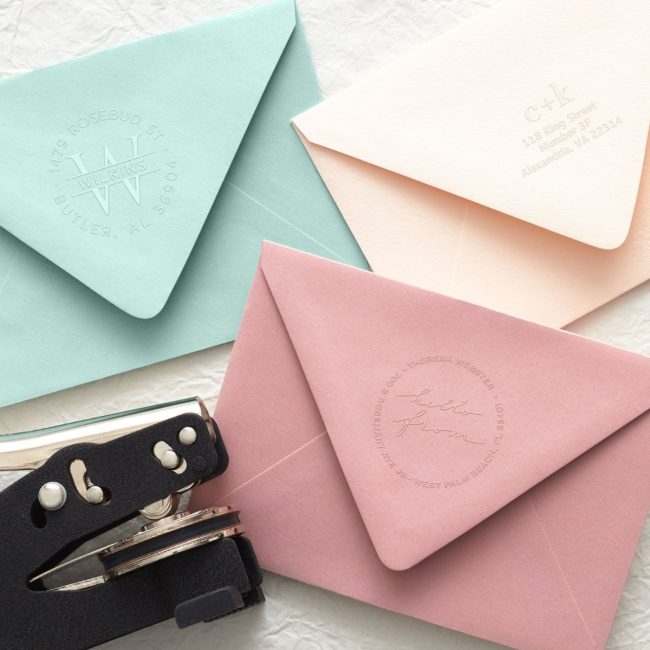
A desk embosser plus a code to design your own plate online, with return address and monogram styles to choose from. Press it onto the back flap of every invitation and RSVP envelope and you never need return-address labels (Emily Post’s dos and don’ts say no address labels on wedding invitations). Paper Source says plates take two to three business days to make, then ship. The redemption code is printed inside the box, so don’t toss the packaging, and plates can’t ship outside the U.S.
For the couple who wants the envelope to feel like an event
Paper Source Envelope Seal Kit
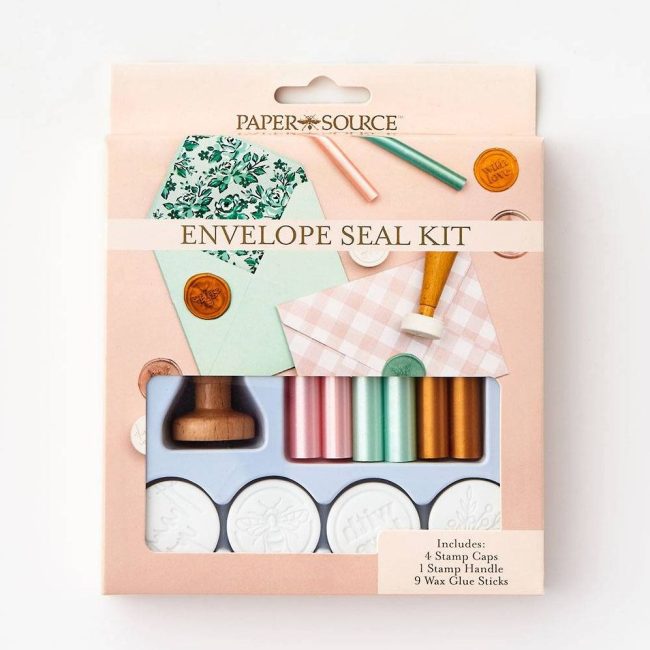
A stamp handle, four stamp heads and nine wax sticks in pink, mint and copper. A wax seal on the inner envelope or the vellum wrap is the cheapest way to make a $3 invitation look like a $9 one. The wax comes as glue-gun sticks and the kit doesn’t include a glue gun, so plan on a mini one. Do a test run of ten before you seal 150.
Printing and postage add up fast. Our wedding budget breakdown shows what couples spend on stationery next to everything else.
Wedding invitation wording mistakes to avoid
Putting registry links on the invitation
Emily Post is blunt about it. The registry goes on your wedding website, and your parents and wedding party can pass it along when people ask.
Writing “and guest”
Use the plus-one’s name if you know it. Emily Post calls named invitations “much warmer and more welcoming.”
Mixing up honour and pleasure
“Honour of your presence” is for a house of worship. Everywhere else, “pleasure of your company.”
Adding RSVP to a ceremony-only invitation
Emily Post uses RSVP only on reception invitations or combined ceremony-and-reception invitations.
Dropping the state
Spell out the state in full. Emily Post says you can leave it off only if every guest is local. Portland is in Oregon and in Maine.
Proofreading alone
Read every line backward, one word at a time, then hand it to the most pedantic person you know. Check names against how people spell them, not how you think they do.
Wedding invitation wording FAQ
Is it “honor” or “honour” on a wedding invitation?
On a formal invitation for a ceremony in a house of worship, Emily Post uses “honour,” with the British “u,” and “favour” if you write out the reply line (“The favour of a reply is requested”). On a casual invitation, American spelling is fine.
Whose name goes first on a wedding invitation?
In Emily Post’s traditional samples, the bride’s name comes first, then “to” and the groom’s name. Our take: put the host family’s child first, or whichever order sounds better aloud. On a couple-hosted invitation there’s no rule.
Do you put the year on a wedding invitation?
Yes on a formal invitation, written out on its own line in lowercase with no “and” (“two thousand twenty-seven”). On a casual invitation it’s optional, but it makes the card a better keepsake.
Should a wedding invitation say what to wear?
Only “Black tie,” and only in the lower right corner of a formal reception invitation, per Emily Post. Every other dress code goes on the details card or your website.
Once your wording is final, the envelopes are next. Our guide to addressing wedding invitations covers the inner envelope, plus-ones and solo guests, so the outside looks as finished as the card inside.